
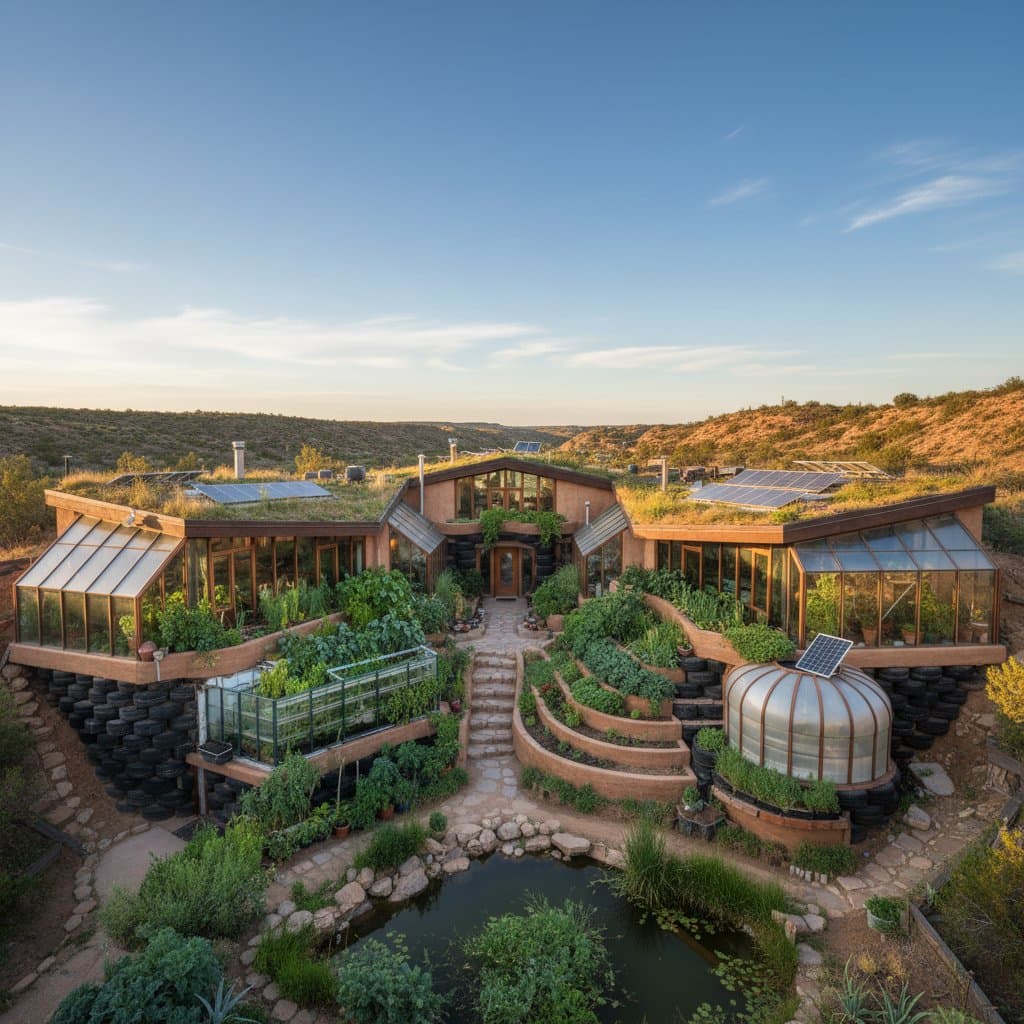
Why Earthships Represent the Future of Sustainable Housing
Consider a home that maintains its own comfort, collects its water, and grows its food. Thick earthen walls retain solar warmth, rainwater channels supply fresh water, and indoor gardens provide year-round harvests. Utility expenses approach zero in this self-regulating environment. Earthships embody this vision, challenging conventional architecture with radical sustainability.
Homeowners often pursue sustainability through add-ons like solar panels or efficient appliances. These measures reduce impact but maintain reliance on external resources. Earthships invert this approach. They integrate natural and recycled elements to function off-grid, converting waste into durable structures, sunlight into energy, and precipitation into potable water.
Origins and Core Principles of Earthship Design
Earthships consist of self-sufficient structures primarily from natural and upcycled materials. Walls form from tires filled with compacted earth, providing thermal mass to stabilize indoor temperatures amid external fluctuations. Interior partitions incorporate bottles and cans in mortar, offering insulation and diffusing sunlight into colorful patterns.
Design elements blend organic curves, south-facing glass arrays, and sloped roofs for rainwater capture. This aesthetic merges primitivism with innovation, suiting a landscape of vulnerable utilities and escalating costs. Earthships prioritize autonomy over conformity.
Key Advantages for Modern Housing Needs
Resource scarcity, climate variability, and financial pressures demand innovative residences. Earthships address these through streamlined ingenuity.
- Energy Autonomy: Solar arrays, passive heating, and ventilation eliminate external power dependence.
- Water Independence: Roof collection and greywater reuse enable self-contained hydration cycles.
- Material Reuse: Recycled components divert waste from landfills and lower embodied energy.
- Integrated Agriculture: Attached greenhouses support continuous crop cultivation in varied conditions.
- Simplified Upkeep: Robust construction minimizes repairs relative to standard dwellings.
Construction Techniques Rooted in Earth
Building an Earthship involves transforming everyday discards into foundational elements. Workers compact soil into tires until each unit rivals concrete in solidity. Stacked like oversized bricks, these form load-bearing walls resistant to temperature extremes and earthquakes. The mass absorbs daytime heat and releases it nocturnally for consistent comfort.
Non-structural walls employ glass bottles or aluminum cans embedded in cement, allowing light to filter through in prismatic displays. Floors receive adobe overlays or burnished concrete for enduring, earthy appeal. This process redefines resources: a discarded tire evolves from liability to asset, fostering resourceful construction mindsets.
Principles of Passive Solar Architecture
Passive solar strategies harness environmental forces without active machinery. South-oriented glazing captures daylight warmth, stored in dense walls for evening release. Overhanging eaves prevent summer overheating, while cross-ventilation channels expel rising heat and admit cooler ground-level air.
Such dynamics obviate heating or cooling units. The structure operates like a biological entity, self-adjusting to diurnal rhythms. Residents often report heightened environmental attunement from this seamless integration.
Integrated Water and Waste Management
Earthships excel in resource cycling, particularly water handling. Roof surfaces direct rainfall into underground cisterns for initial storage. Filtration prepares it for domestic use; post-use greywater irrigates interior vegetation, which purifies it further for sanitary applications. Blackwater routes to exterior plant-based treatment zones, where microbial action and roots achieve natural remediation.
This loop sustains operations in isolated settings, bypassing public infrastructure. It reframes water as a renewable asset in perpetual motion, enhancing household vitality and ecological footprint.
Financial Considerations and Long-Term Value
Initial Earthship expenses may parallel those of standard mid-tier homes, influenced by scale, site preparation, and expert involvement in tire assembly or photovoltaic installation. Custom elements elevate costs for larger or amenity-rich builds.
Post-construction economics shift favorably. Eliminated energy tariffs, absent water fees, and reduced grocery outlays from on-site yields recoup investments over decades. This positions Earthships as viable for fiscal prudence alongside planetary stewardship.
Climate-Specific Adaptations
Originating in arid Southwest designs, Earthships now customize for global variances. Humid regions emphasize enhanced airflow via louvered openings. Cold climates incorporate supplementary insulation and steeper solar angles for maximal gain.
Storm-vulnerable sites feature fortified bases and impermeable barriers against flooding. Core tenets persist, but local tailoring ensures viability, rendering Earthships adaptable prototypes for worldwide deployment.
Navigating Regulations and Expertise
Erecting an Earthship demands compliance with zoning and building codes. Progressive areas embrace eco-builds; conservative ones require rigorous substantiation of structural integrity and system efficacy. Engage specialists versed in alternative methods to streamline approvals.
Documentation must verify water treatment, waste processing, and energy provisions align with health mandates. Though laborious, this yields a compliant, superior habitat exceeding baseline efficiencies.
Significance of Tire Utilization
Tires serve dual roles in Earthships: functional and emblematic. Their ubiquity, durability, and disposal challenges make them ideal repurposing candidates. Integrated into walls, they mitigate landfill burdens while yielding seismic-stable enclosures.
This choice symbolizes defiance against waste culture, affirming that endurance stems from revaluation. Structures emerge tethered to terrestrial origins, embodying permanence.
Embracing Earthship Daily Life
Inhabitants cultivate intentionality in an Earthship. Awareness sharpens around consumption patterns, as visible mechanisms like photovoltaic output or hydroponic vitality underscore impacts. The design prompts deliberate engagement with natural flows.
A pervasive tranquility arises from this synergy. Living spaces pulse with seasonal cadences, converting routines into regenerative practices over mere utility.
Contemporary Earthship Builders and Variations
Earthships span isolated retreats to urban infills, drawing eco-activists, health-conscious families, and innovators alike. Professionals now fuse principles with sleek facades, harmonizing utility and elegance.
Global examples adapt to terrains: some substitute rammed earth for tires, others augment with geothermal exchanges. The ethos endures: leverage local abundances, eliminate excess, prioritize equilibrium.
Steps to Realize Your Earthship
Ignite your project by studying system interdependencies. Tour existing installations or consult architects specializing in off-grid builds. Evaluate your property for solar access, soil stability, and hydrological potential.
Advance by listing your vision on Doric South at no cost. Connect with certified experts in sustainable methods to navigate design, approvals, and execution. Opt for pure Earthships or hybrids incorporating select features; professional input ensures success.
Evolving with Your Earthship
Post-completion, refine elements iteratively. Introduce diverse flora to greenhouses, optimize filtration sequences, or scale renewable capacities. Personalize with regional motifs in glass embeds or textured exteriors.
This ongoing dialogue sustains relevance, mirroring life's adaptability.