
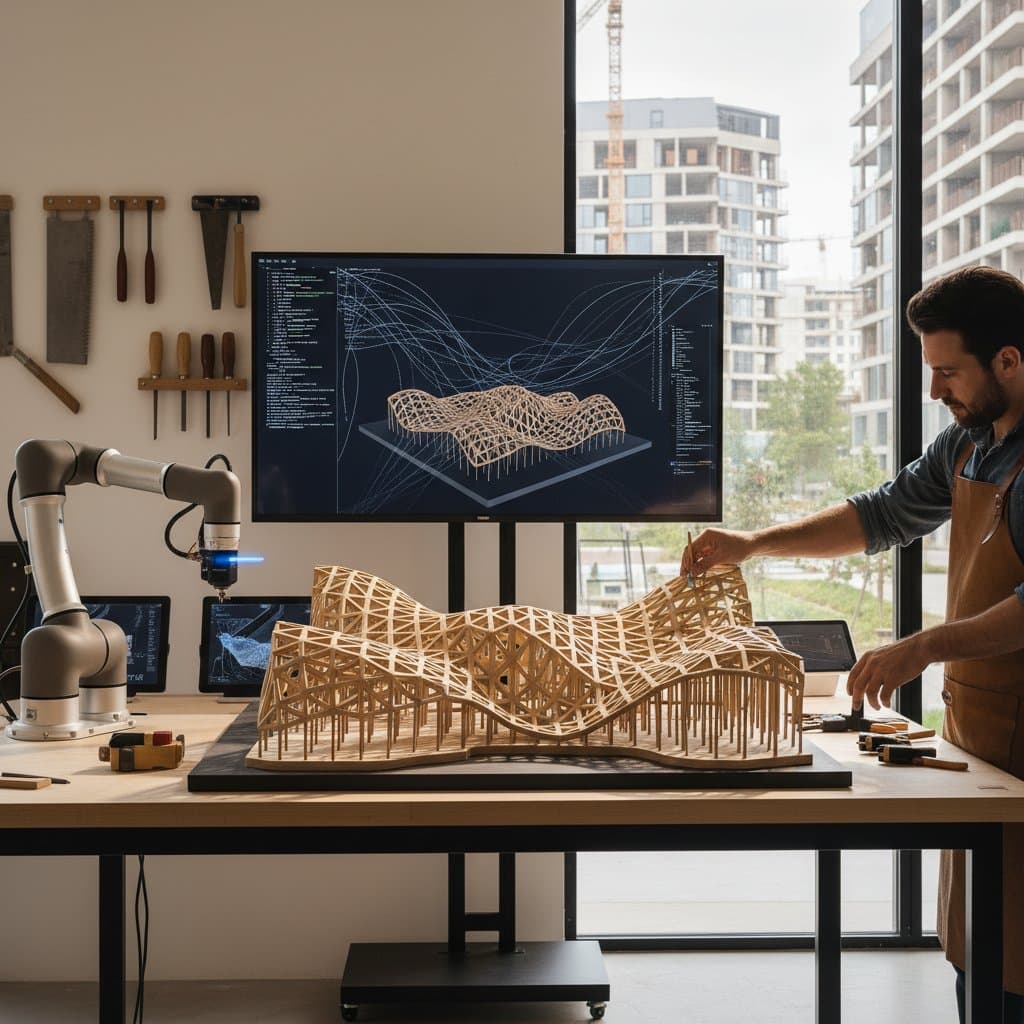
Digital Craft: Blending Artisan Skill with Tech Innovation
Imagine running your hand along a wall that seems alive with pattern. Every curve and contour emerges from a designer's intuition combined with the precision of digital tools. This approach appears in hand-finished timber panels cut by robotic arms, ceramic tiles with algorithm-responsive glazes, and sculptural facades that integrate code with clay. The boundary between hand and machine blurs, creating innovative outcomes.
The term digital craftsmanship often arises in design discussions. It pairs the tactile nature of craft with technology, which might seem contradictory. However, digital craft extends possibilities rather than replacing the artisan. It provides methods to shape ideas, construct structures, and animate materials with precision that retains a personal touch.
The Evolution of Craft Tools
Craft evolves with its tools. The chisel transformed stonework, and the printing press altered how artists disseminated their work. Digital fabrication tools, such as 3D printers, CNC routers, and parametric modeling software, represent the current advancement. These enable artisans and architects to explore complex geometries, responsive materials, and lightweight structures previously unattainable by manual means.
The essence of craft persists. It centers on care, touch, and intuition. The artisan's awareness of proportion, texture, and detail infuses digital processes with vitality. Without this human perspective, digital outputs risk sterility. The value emerges from the interaction between algorithm and hand, code and craft.
Integrating Art and Algorithms
Consider a woodworker partnering with software. The artisan outlines the concept, sketching curves and forms that align with intuition. Parametric design software converts these into a dynamic system of interconnected elements. Adjusting one curve prompts the entire structure to adapt in real time, preserving balance and proportion.
These models function as responsive frameworks. They incorporate environmental data, structural requirements, or aesthetic choices. Parameters for light penetration, airflow, or material flexibility guide refinements to the form. Upon achieving optimal balance, fabrication tools execute the design with exact measurements. The artisan then applies finishing touches by hand, adjusting surfaces and ensuring the piece conveys life.
Examples in Architecture and Design
Digital craft manifests in diverse architectural projects. A pavilion might draw from leaf veins for its structure. The parametric model adjusts to wind loads, sunlight angles, and visitor movement. Thin plywood sheets form the framework via CNC routing, followed by manual assembly for precise joints. The outcome blends futuristic elements with organic familiarity, resembling a grown rather than constructed form.
Ceramic makers employ 3D printing for molds that previously demanded days of carving. The printer ensures accuracy, while glazing, firing, and finishing depend on the artisan's judgment. This combination yields surfaces that balance perfection with subtle variations, creating a rhythmic visual effect unique to skilled craft.
The Role of Parametric Design
Parametric design forms the foundation of digital craftsmanship. It transcends mere shape creation by emphasizing relationships. Dimensions, angles, and textures link through established parameters. Altering one element triggers automatic adjustments across the model. This method offers substantial flexibility to creators.
A furniture studio might apply parametric software to scale a table according to room dimensions or material stock. A facade specialist could simulate perforations that modulate based on daily sunlight, optimizing interior comfort alongside visual unity. These techniques conserve time and resources while unlocking creative avenues beyond conventional drafting.
Amplifying Skills Through Technology
Digital craft amplifies rather than supplants artisan expertise. Optimal outcomes arise from individuals versed in both material properties and digital principles. A wood specialist, familiar with bending under stress, incorporates that insight into parametric models, aligning digital parameters with physical realities.
This collaboration fosters an innovation cycle. The artisan inputs data to instruct the machine, which in turn provides analytical feedback to broaden creative horizons. The process echoes historical workshops where knowledge passed between masters and apprentices, now extended to include algorithmic contributions.
Navigating Digital Workshop Challenges
Integrating technology into craft presents obstacles. Equipment costs money, and mastering digital interfaces demands investment in learning. Software changes can interrupt routines, while machines require ongoing upkeep and calibration. These issues parallel the commitment inherent in traditional craft, demanding persistence and inquiry.
Safety protocols prove crucial. Training and protective equipment support operation of CNC routers or laser cutters. Systems for dust removal, ventilation, and noise mitigation warrant attention. Despite their modern appearance, these tools function as robust industrial devices needing careful handling.
Financial considerations influence adoption. Digital methods minimize waste and enhance accuracy, yet initial investments loom large. Smaller operations often outsource fabrication initially, building toward in-house capabilities. Partnerships with community fabrication labs or maker spaces facilitate entry, enabling trials without immediate full-scale expenses.
Revitalizing Local Production
Digital craft reinvigorates community-based manufacturing. Digital files permit design in one location and production nearby with regional materials. This strategy lowers transport expenses and bolsters local economies. Close artisan-fabricator relationships ensure pieces capture environmental textures and hues.
An artisan-architect could develop a brick pattern echoing regional history, executed with robotic precision. The work respects heritage while incorporating efficient techniques. Such practices align with demands for sustainable, context-sensitive design.
Steps to Explore Digital Craft
Artisans, designers, or architects interested in digital craftsmanship can begin accessibly. No immediate programming proficiency proves necessary. Select a parametric platform like Rhino with Grasshopper or Fusion 360 for initial exploration. Tackle modest projects, such as a bespoke light fixture or decorative tile.
- Develop a defined concept. Identify the piece's intended expression prior to software engagement.
- Grasp parameter fundamentals. Recognize how rules govern geometry and test adjustments to observe model reactions.
- Engage collaborators. Work with nearby fabricators or digital specialists to materialize designs.
- Iterate via production. Interact with the output, assess material qualities, and integrate lessons into future iterations.
- Anchor in core skills. Software handles computations, but intuition discerns appropriateness. Direct technology with human judgment.
Experiencing Digital Craft in Practice
Incorporating digitally crafted elements into everyday spaces blends exactness with warmth. Light may play across a parametric divider, or a machine-cut wooden element might retain a handmade texture to the touch. This interplay of structure and feeling defines its allure.
Digital craft demonstrates technology's capacity to enhance rather than diminish design. It revives workshop traditions while empowering creators to manipulate form and utility with exceptional range. Proficiency in both craft and code shapes the trajectory of architecture and design.